AP2 Mandates Extension
Overview
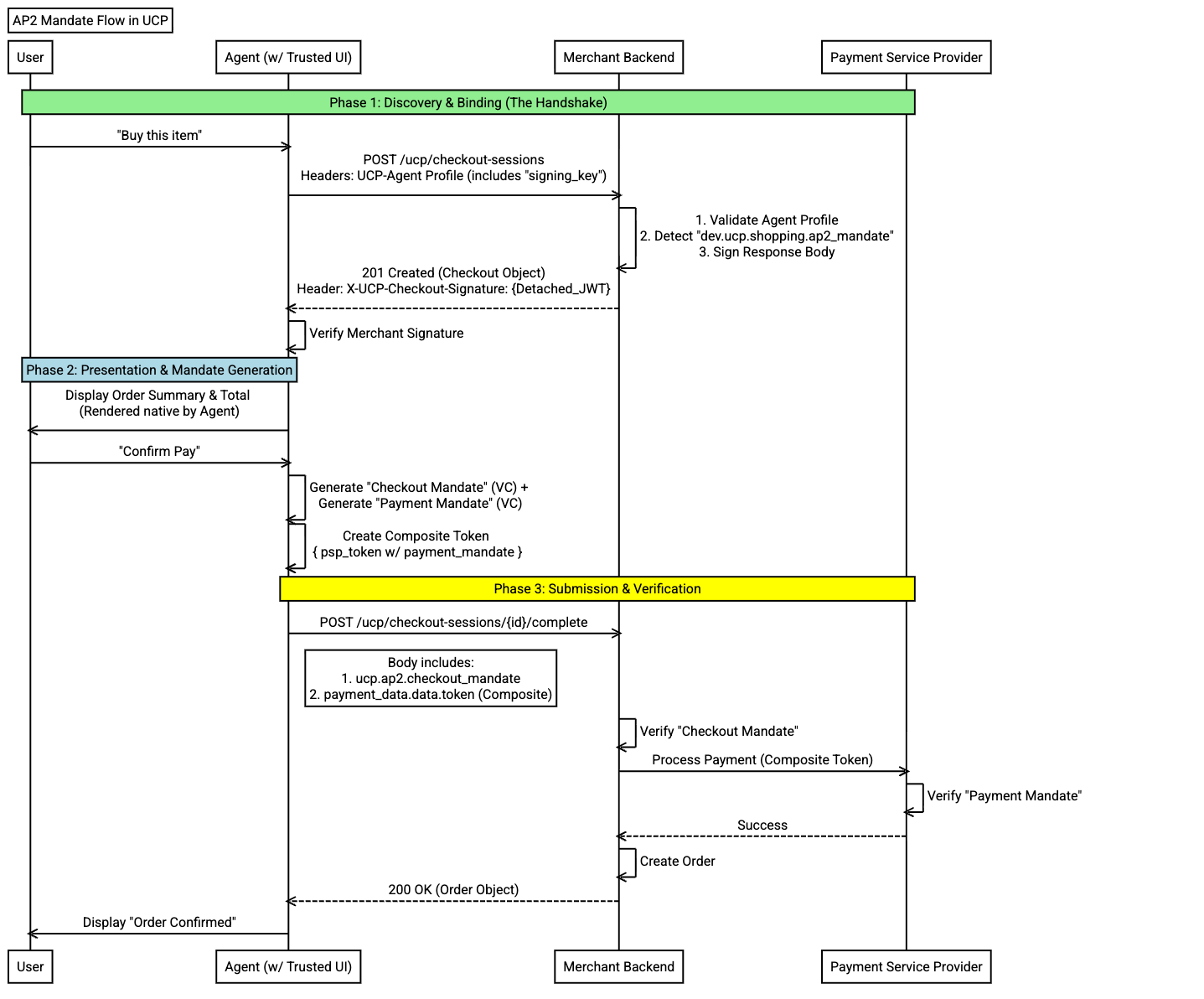
The AP2 Mandates extension enables the secure exchange of user intents and authorizations using Verifiable Digital Credentials. It extends the standard Shopping Service Checkout capability to support the AP2 Protocol.
When this capability is negotiated and active, it transforms a standard checkout session into a cryptographically bound agreement:
- Businesses MUST embed a cryptographic signature in checkout responses, proving the terms (price, line items) are authentic.
- Platforms MUST provide cryptographically signed proofs (Mandates)
during the
completeoperation, proving the user explicitly authorized the specific checkout state and funds transfer.
Security Binding: Once this extension is negotiated in the capability intersection, the session is Security Locked. Neither party may revert to a standard (unprotected) checkout flow.
Design
All AP2-specific fields are nested under an ap2 object in both requests and
responses. This design provides:
- Schema modularity — Base checkout schema stays clean; AP2 adds one field containing all its data.
- Consistent canonicalization — One rule: exclude
ap2from the business's signature computation. Future AP2 fields are automatically handled. - Extension coexistence — Multiple security extensions can coexist without namespace collisions.
- Capability signal — Presence of
ap2object clearly indicates AP2 is active.
Discovery & Negotiation
This extension follows the standard UCP negotiation protocol. It is activated only when it appears in the Capability Intersection of both the business and the platform.
Business Profile Advertisement
Businesses declare support by adding dev.ucp.shopping.ap2_mandate to their
capabilities list in /.well-known/ucp.
Business Profile Example:
{
  "capabilities": {
    "dev.ucp.shopping.checkout": [
      {
        "version": "draft",
        "spec": "https://ucp.dev/draft/specification/checkout",
        "schema": "https://ucp.dev/draft/schemas/shopping/checkout.json"
      }
    ],
    "dev.ucp.shopping.ap2_mandate": [
      {
        "version": "draft",
        "spec": "https://ucp.dev/draft/specification/ap2-mandates",
        "schema": "https://ucp.dev/draft/schemas/shopping/ap2_mandate.json",
        "extends": "dev.ucp.shopping.checkout",
        "config": {
          "vp_formats_supported": {
            "dc+sd-jwt": { }
          }
        }
      }
    ]
  }
}
Platform Profile Advertisement
Platforms declare support in their profile. If the platform is operating under
the trusted platform provider model, the platform MUST provide at least one
key in the top-level signing_keys array in their profile.
Activation and Session Locking
- The platform advertises its profile URI (transport-specific mechanism).
- The business fetches the profile and computes the intersection.
- If
dev.ucp.shopping.ap2_mandateis present in the intersection:- The business MUST include
ap2.merchant_authorizationin all checkout responses. - The business MUST NOT accept a
complete_checkoutrequest that lacksap2.checkout_mandate. - The platform MUST verify the business's signature before presenting the checkout to the user.
- The business MUST include
Signing Key Requirements
To utilize this extension, a public signing key MUST be available for the business to verify the mandate's signature.
- Platform Provider Flow: Key provided in the platform profile's
signing_keys. - User Credential Flow: Key bound to the digital payment credential.
If a public key cannot be resolved, or if the signature is invalid, the business MUST return an error.
Cryptographic Requirements
This extension uses the cryptographic primitives defined in the Message Signatures specification:
- Algorithms: ES256 (required), ES384, ES512
- Canonicalization: JCS (RFC 8785)
- Key Format: JWK (RFC 7517)
- Key Discovery:
signing_keys[]in/.well-known/ucp(see Key Discovery)
See Message Signatures for complete details on algorithms, key format, and key rotation.
Business Authorization
Businesses MUST embed their signature in the checkout response body under
ap2.merchant_authorization using JWS Detached Content format
(RFC 7515 Appendix F).
Checkout Response with Embedded Signature:
{
  "id": "chk_abc123",
  "status": "ready_for_complete",
  "currency": "USD",
  "line_items": [...],
  "totals": [...],
  "ap2": {
    "merchant_authorization": "eyJhbGciOiJFUzI1NiIsImtpZCI6Im1lcmNoYW50XzIwMjUifQ..<signature>"
  }
}
The merchant_authorization value is a JWS with detached payload in the format
<header>..<signature>. The double dot (..) indicates the payload is
transmitted separately (as the checkout body itself).
JWS Header Claims:
| Claim | Type | Required | Description |
|---|---|---|---|
alg |
string | Yes | Signature algorithm (ES256, ES384, ES512) |
kid |
string | Yes | Key ID referencing the business's signing_keys |
Signature Computation:
The signature MUST cover both the JWS header and the checkout payload. This
prevents algorithm substitution attacks where an attacker modifies the alg
claim without invalidating the signature.
sign_checkout(checkout, private_key, kid, alg="ES256"):
    // Extract payload (checkout minus ap2)
    payload = checkout without "ap2" field

    // Canonicalize using JCS (RFC 8785)
    canonical_bytes = jcs_canonicalize(payload)

    // Create protected header
    header = {"alg": alg, "kid": kid}
    encoded_header = base64url_encode(json_encode(header))

    // Sign header + payload per JWS
    signing_input = encoded_header + "." + base64url_encode(canonical_bytes)
    signature = sign(signing_input, private_key, alg)

    // Return detached JWS (header..signature, no payload)
    checkout.ap2.merchant_authorization = encoded_header + ".." + base64url_encode(signature)
    return checkout
Mandate Structure
Mandates are SD-JWT credentials with Key Binding (+kb). The platform
MUST produce two distinct mandate artifacts:
| Mandate | UCP Placement | Purpose |
|---|---|---|
| checkout_mandate | ap2.checkout_mandate |
Proof bound to checkout terms, protects business |
| payment_mandate | payment.instruments[*].credential.token |
Proof bound to payment authorization, protects funds |
The checkout mandate MUST contain the full checkout response including the
ap2.merchant_authorization field. This creates a nested cryptographic binding
where the platform's signature covers the business's signature.
Specification Boundary: This extension defines where mandates are placed in UCP requests and responses. The mandate credential structure (claims, selective disclosure, key binding) is defined by the AP2 Protocol Specification.
Canonicalization
All JSON payloads MUST be canonicalized using JSON Canonicalization Scheme (JCS) per RFC 8785.
Why JCS for Mandates? UCP request signatures use Content-Digest (raw
bytes) without canonicalization — the request is signed and verified
immediately over the same HTTP connection. Mandates are different:
- Durability — Mandates are stored as evidence of user consent. They may be retrieved and verified days or months later.
- Cross-system transmission — Mandates pass through multiple systems (platform → business → PSP → card network) that may re-serialize JSON.
- Reproducibility — Any party must reconstruct the exact signed bytes from the logical JSON content, regardless of serialization differences.
JCS ensures that semantically identical JSON produces byte-identical output, making signatures reproducible across implementations and time.
AP2-Specific Rule: When computing the business's merchant_authorization
signature, exclude the ap2 field entirely. This ensures future AP2 fields
are automatically handled.
The Mandate Flow
Once the dev.ucp.shopping.ap2_mandate capability is negotiated, the session
is locked into the following flow. Both parties MUST follow these steps to
ensure cryptographic integrity; any attempt to bypass these steps or submit
a completion request without mandates MUST result in a session failure.
Step 1: Checkout Creation & Signing
The platform initiates the session. The business returns the Checkout object
with ap2.merchant_authorization embedded in the response body.
| Name | Type | Required | Description |
|---|---|---|---|
| ucp | any | Yes | UCP metadata for checkout responses. |
| id | string | Yes | Unique identifier of the checkout session. |
| line_items | Array[object] | Yes | List of line items being checked out. |
| buyer | object | No | Representation of the buyer. |
| status | string | Yes | Checkout state indicating the current phase and required action. See Checkout Status lifecycle documentation for state transition details. Enum: incomplete, requires_escalation, ready_for_complete, complete_in_progress, completed, canceled |
| currency | string | Yes | ISO 4217 currency code reflecting the merchant's market determination. Derived from address, context, and geo IP—buyers provide signals, merchants determine currency. |
| totals | Array[object] | Yes | Different cart totals. |
| messages | Array[object] | No | List of messages with error and info about the checkout session state. |
| links | Array[object] | Yes | Links to be displayed by the platform (Privacy Policy, TOS). Mandatory for legal compliance. |
| expires_at | string | No | RFC 3339 expiry timestamp. Default TTL is 6 hours from creation if not sent. |
| continue_url | string | No | URL for checkout handoff and session recovery. MUST be provided when status is requires_escalation. See specification for format and availability requirements. |
| payment | object | No | Payment configuration containing handlers. |
| order | object | No | Details about an order created for this checkout session. |
| ap2 | any | No |
Example Response:
{
  "id": "chk_abc123",
  "status": "ready_for_complete",
  "currency": "USD",
  "line_items": [
    {
      "id": "li_1",
      "item": {"id": "item_123", "title": "Widget", "price": 2500},
      "quantity": 2,
      "totals": [
        {"type": "subtotal", "amount": 5000},
        {"type": "total", "amount": 5000}
      ]
    }
  ],
  "totals": [
    {"type": "subtotal", "amount": 5000},
    {"type": "tax", "amount": 400},
    {"type": "total", "amount": 5400}
  ],
  "ap2": {
    "merchant_authorization": "eyJhbGciOiJFUzI1NiIsImtpZCI6Im1lcmNoYW50XzIwMjUifQ..<signature>"
  }
}
The platform MUST verify the signature:
verify_merchant_authorization(checkout, merchant_profile):
    // Parse detached JWS (header..signature)
    jws = checkout.ap2.merchant_authorization
    [encoded_header, empty, encoded_signature] = jws.split(".")

    // Decode and validate header
    header = json_decode(base64url_decode(encoded_header))
    assert header.alg in ["ES256", "ES384", "ES512"]

    // Reconstruct signed payload (checkout minus ap2)
    payload = checkout without "ap2" field
    canonical_bytes = jcs_canonicalize(payload)

    // Reconstruct signing input (header + payload)
    signing_input = encoded_header + "." + base64url_encode(canonical_bytes)

    // Get business's public key and verify
    public_key = get_key_by_kid(merchant_profile.signing_keys, header.kid)
    return verify(encoded_signature, signing_input, public_key, header.alg)
Step 2: User Consent & Mandate Generation
When the user confirms the purchase, the platform MUST facilitate the generation of cryptographically verifiable mandates.
Option 1: Trusted Platform Provider
A trusted platform provider acts on the user's behalf to generate the mandate credentials. The platform provider MUST ensure that mandates are not created without explicit user consent from trusted, deterministic channels.
Upon user consent, the platform signs the mandates using their server-side key. The business trusts the platform's signature implies user consent.
Option 2: Digital Payment Credential
In this model the user has a VDC issued from a source trusted by the business (for example: a digital payment credential issued by a bank or network).
The platform requests a presentation via a protocol like OpenID4VP. The User's Wallet (or equivalent) processes the request and signs the mandates using the private key associated with their payment credential.
The business trusts the Credential Issuer (Bank) and verifies the user's Key Binding (+kb) signature.
Step 3: Submission (complete_checkout)
Once the mandates are generated, the platform submits them in the completion request:
| Name | Type | Required | Description |
|---|---|---|---|
| checkout_mandate | string | No | SD-JWT+kb proving user authorized this checkout. |
{
  "payment": {
    "instruments": [
      {
        "id": "instr_1",
        "handler_id": "gpay_1234",
        "type": "card",
        "selected": true,
        "display": {
          "description": "Visa •••• 1234",
        },
        "billing_address": {
          "street_address": "123 Main St",
          "address_locality": "Anytown",
          "address_region": "CA",
          "address_country": "US",
          "postal_code": "12345"
        },
        "credential": {
          "type": "PAYMENT_GATEWAY",
          "token": "examplePaymentMethodToken"
        }
      }
    ]
  },
  "ap2": {
    "checkout_mandate": "eyJhbGciOiJFUzI1NiIsInR5cCI6InZjK3NkLWp3dCJ9..." // The User-Signed SD-JWT+kb / platform provider signed SD-JWT / delegated SD-JWT-KB
  }
}
ap2.checkout_mandate: The SD-JWT+kb checkout mandate containing the full checkout (withap2.merchant_authorization)payment.instruments[*].credential.token: Contains the payment mandate (composite token)
Verification & Processing
Business Verification
Upon receiving the complete request, the business MUST:
- Enforce Negotiation: If AP2 was negotiated, reject the request with
mandate_requirederror code ifap2.checkout_mandateis missing.
Mandate Verification (per AP2 spec):
- Verify Mandate: Decode and verify the SD-JWT signature, key binding, and expiration per the AP2 Protocol Specification.
- Extract Embedded Checkout: Extract the checkout object from the verified mandate claims.
UCP Verification:
-
Verify Business Authorization: Confirm
ap2.merchant_authorizationin the embedded checkout is the business's own valid signature:jws = embedded_checkout.ap2.merchant_authorization [encoded_header, _, encoded_signature] = jws.split(".") header = json_decode(base64url_decode(encoded_header)) payload = embedded_checkout without "ap2" field signing_input = encoded_header + "." + base64url_encode(jcs_canonicalize(payload)) my_key = get_key_by_kid(my_signing_keys, header.kid) verify(encoded_signature, signing_input, my_key, header.alg) -
Verify Terms Match: Confirm the embedded checkout terms match the current session state (id, totals, line items).
PSP Verification
The business passes the token (composite object) to their Payment
Handler / PSP. The PSP verifies the payment_mandate per the
AP2 Protocol Specification,
including signature validation, expiration, and correlation with the
checkout.
Schema
Business Authorization
JWS Detached Content signature (RFC 7515 Appendix F) over the checkout response body (excluding ap2 field). Format: <base64url-header>..<base64url-signature>. The header MUST contain 'alg' (ES256/ES384/ES512) and 'kid' claims. The signature covers both the header and JCS-canonicalized checkout payload.
Pattern: ^[A-Za-z0-9_-]+\.\.[A-Za-z0-9_-]+$
AP2 Checkout Response
The ap2 object included in checkout responses.
| Name | Type | Required | Description |
|---|---|---|---|
| merchant_authorization | string | No | Merchant's signature proving checkout terms are authentic. |
Checkout Mandate
SD-JWT+kb credential in ap2.checkout_mandate. Proving user authorization for the checkout. Contains the full checkout including ap2.merchant_authorization.
Pattern: ^[A-Za-z0-9_-]+\.[A-Za-z0-9_-]*\.[A-Za-z0-9_-]+(~[A-Za-z0-9_-]+)*$
AP2 Complete Request
The ap2 object included in COMPLETE checkout requests.
| Name | Type | Required | Description |
|---|---|---|---|
| checkout_mandate | string | No | SD-JWT+kb proving user authorized this checkout. |
Error Codes
Error codes specific to AP2 mandate verification.
Enum: mandate_required, agent_missing_key, mandate_invalid_signature, mandate_expired, mandate_scope_mismatch, merchant_authorization_invalid, merchant_authorization_missing
| Error Code | Description |
|---|---|
mandate_required |
AP2 was negotiated, but the request lacks ap2.checkout_mandate. |
agent_missing_key |
Platform profile lacks a valid signing_keys entry. |
mandate_invalid_signature |
The mandate signature cannot be verified. |
mandate_expired |
The mandate exp timestamp has passed. |
mandate_scope_mismatch |
The mandate is bound to a different checkout. |
merchant_authorization_invalid |
The business authorization signature could not be verified. |